

| Area | 3,10 Ha |
| Grape variety | 80% Merlot, 20% Cabernet Franc |
| Average age | 30 years |
| Sol | clay-sandy |
| Location | one of the jewels of the Libournais wines, near the town of Néac |
 Security
100% secure end-to-end payments. An optimal costing system.
 Delivery policy
Free delivery from 60 bottles purchased on the site
 Customer service
Customer service available on +33 (0) 5 57 84 21 17 / contact@vignoblesbertin.com
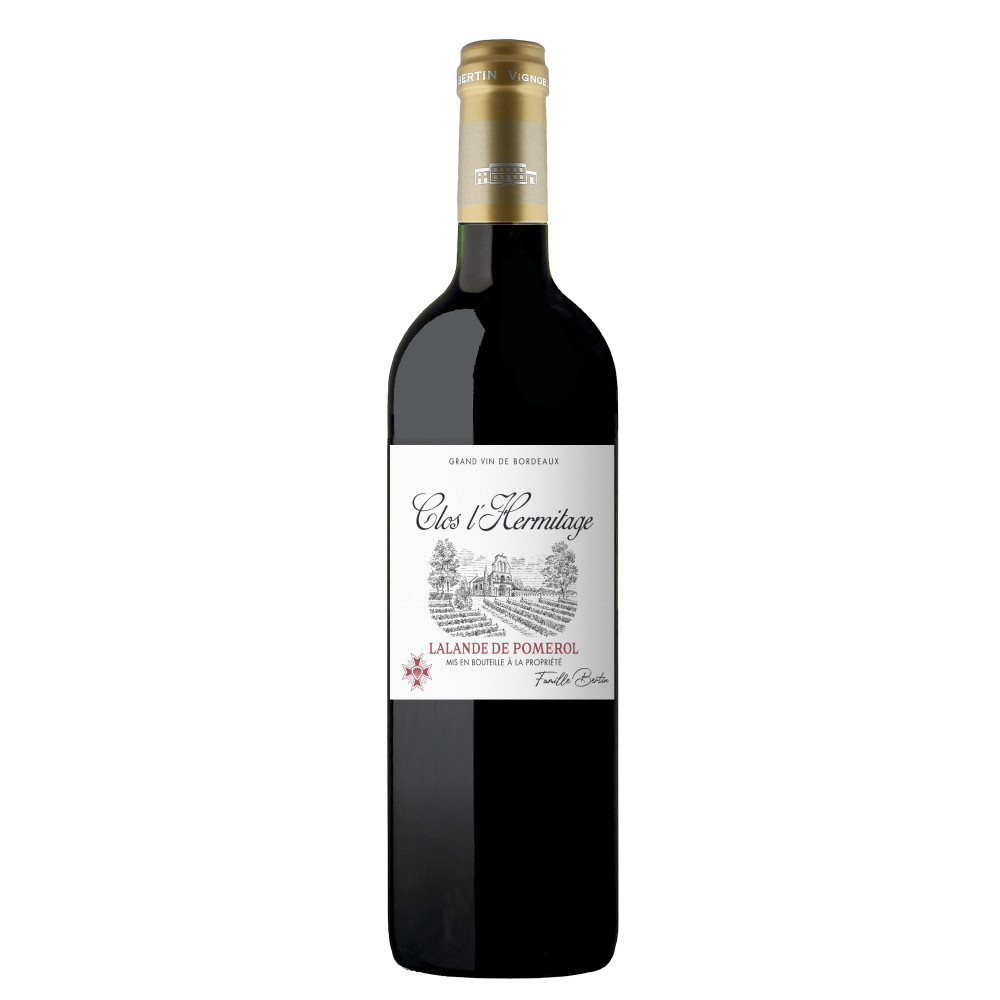
To the eye, Clos L’Hermitage reveals a deep purple red appearance, a sign of an intense wine with good aging potential.
The nose is generous and aromatic, marked by fresh notes of morello cherry and ripe red fruits. These aromas invite tasting with great intensity.
On the palate, the wine stands out with a well-balanced structure, carried by silky and ripe tannins. Its pleasant length underscores a gourmet and harmonious character, with intense aromas of fruits and spices that persist on the finish.
The Clos l’Hermitage captivates from the first tasting with its gourmet and warm character. Its intense aromas of ripe red fruits, accompanied by subtle spicy notes, announce great complexity. On the palate, this wine distinguishes itself with its balanced structure and silky tannins that envelop the palate with finesse. Its pleasant length prolongs the pleasure, offering a rich and harmonious experience, perfect for accompanying convivial meals or moments of sharing.
It is ideally enjoyed between 16 and 18°C. This temperature allows the full expression of the wine's aromatic richness while maintaining its balance on the palate.
The Clos L’Hermitage pairs perfectly with characterful dishes. It elegantly accompanies a grilled ribeye, leg of lamb, or veal roast with small vegetables. It also reveals all its richness with hard cheeses, for a gourmet and balanced tasting.
As always, the vinification aims to preserve the quality of grapes harvested at optimal maturity and to express the potential of the sandy-clay terroir of Néac. After being harvested, the grapes are destemmed and crushed then subjected to a pre-fermentative maceration at cold for 3 to 5 days at around 8°C. This aqueous phase step allows gentle extraction of aromatic compounds as well as anthocyanins responsible for the color.
The alcoholic fermentation takes place at controlled temperature: pumping over is done twice a day, rack and returns are performed on each tank 3 times during the entire fermentation, allowing the best extraction of compounds responsible for the wine's structure, with gentleness and elegance without crushing the grapes.
The alcoholic fermentation is followed by a post-fermentative maceration at hot around 29°C for 8 to 10 days. This phase promotes tannin extraction contained in the grape skins and seeds to structure the wine while preserving its balance.
The malolactic fermentation is then conducted to bring suppleness and roundness to the whole. Vinification is done exclusively in stainless steel tanks to preserve the freshness and fruity expression of the wine, without woody influence.
The aging continues for 18 months in cement tanks.
A portion is aged in wood (French oaks from the Tronçais forest).
Close collaboration with the Taransaud cooperage located in the Cognac region allows rigorous selection of the woods used for aging, with medium toasting to avoid over-oaking the wines. The goal is to strengthen the structure, add aromatic complexity without masking the fruit aromas.
Taransaud - Excellence in Cooperage
Located just north of Pomerol, the Lalande-de-Pomerol appellation is separated from its prestigious neighbor by a small stream: the Barbanne. It spans two communes, Lalande and Néac, where landscapes vary between flat soils in the west and more hilly slopes in the east. This relief, combined with great soil diversity, allows for the production of wines with very varied styles.
The king grape here is Merlot. It makes up the bulk of the blends, often complemented by Cabernet Franc, Malbec, or Cabernet Sauvignon. The resulting wines are recognizable by their deep red color, rich nose of ripe red fruits, and round, velvety palate with present but elegant tannins.
Lalande-de-Pomerol benefits from a temperate oceanic climate, softened by the proximity of waterways: the Dordogne, the Isle, and other small streams. These natural conditions promote optimal grape ripening while protecting the vines from spring frosts.
The appellation, covering a little over 1,100 hectares, is a choice alternative to Pomerol: less expensive, but often produced with the same care, on similar terroirs.
They pair perfectly with red meats, slow-cooked or lightly spiced dishes, as well as some exotic cuisines. To be enjoyed young or after a few years of aging (up to 10 years), these wines reveal the full potential of a terroir often in the shadow of its neighbor.
| Area | 3,10 Ha |
| Grape variety | 80% Merlot, 20% Cabernet Franc |
| Average age | 30 years |
| Sol | clay-sandy |
| Location | one of the jewels of the Libournais wines, near the town of Néac |